Content & Design
5 Minutes
How Much Should a Small Business Budget for Social Media in 2026?
Last Updated
July 17, 2026

.avif)
A small business social media budget in the UK in 2026 realistically starts at around £300 a month for professionally managed content and climbs past £3,000 a month for an agency or a full-time hire. That's a tenfold spread for what sounds like the same line item, and it's why so many owners either overspend on a retainer they don't need or underspend on something that quietly stops working by March.
The spread exists because you're not pricing one product. You're choosing between four different ways of resourcing the work: your own time, a freelancer, an employee, or an external team. Each has a genuine cost, including the ones that never appear on an invoice. Here's what each route actually costs in 2026, with real numbers.
For organic social media handled properly, £300–£1,500 per month is the realistic budget range for most UK small businesses in 2026. Below that, you're doing it yourself and paying in time. Above that, you're into agency retainers and in-house salaries, which only make sense once social media is a proven revenue channel for you rather than a presence you need to maintain.
A more useful frame than a percentage-of-revenue rule: budget for the minimum spend that guarantees consistency. Across the 200+ brands we manage at Kraken, the accounts that grow aren't the ones with the biggest budgets. They're the ones that publish well-designed, on-brand content every single week without gaps. Consistency, not frequency, is what actually builds brand awareness, and an ambitious budget you abandon in month three is worth less than a modest one you sustain for a year.
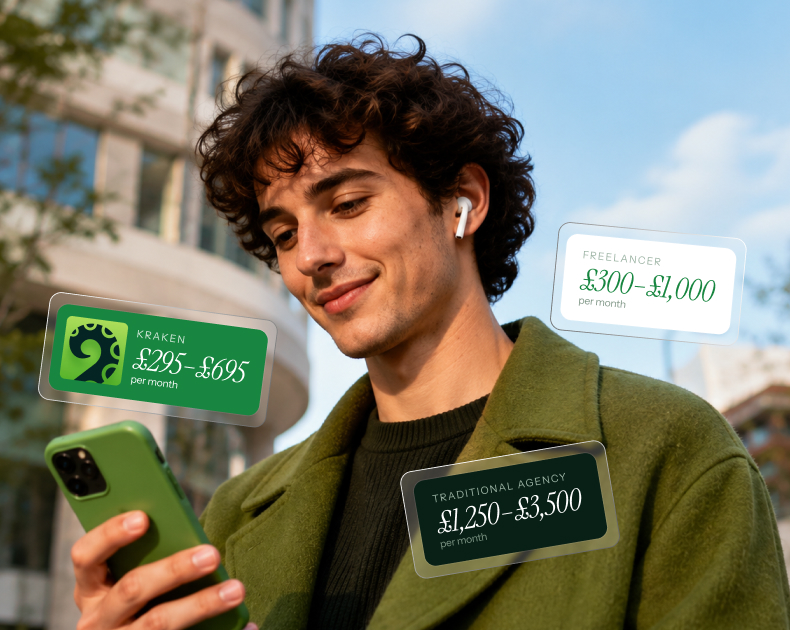
Here's how the four resourcing routes compare on real 2026 UK numbers, before any paid advertising:
The rest of this article unpacks where those numbers come from.
DIY social media costs almost nothing in cash and a great deal in time. Three posts a week, done to a standard that reflects well on your business, means ideation, design, copywriting, scheduling, and checking what's working. At a conservative hour per post, that's over 12 hours a month, and in practice it's usually more because you're switching into it cold each time.
The honest test is your own effective hourly rate. If your time is worth £50 an hour to the business, "free" social media costs £600+ a month, and it's coming out of the hours you'd otherwise spend on sales or operations. The pattern we see constantly: DIY feeds don't fail on quality, they fail on continuity. A busy fortnight becomes a quiet month, and new customers land on a feed that was last updated in the spring. A dormant feed reads as a dormant business.
DIY is still the right call in two cases: you genuinely enjoy it and protect the time, or your brand's appeal is your unfiltered founder voice, which nobody else can produce for you.
The average day rate for freelance social media professionals in the UK is £334, or around £42 an hour, according to YunoJuno's freelancer rates report. For a small business retainer, that maths matters: even a light arrangement of two days a month puts you at £668, and a freelancer producing content weekly will typically quote £500–£1,000 a month depending on experience and scope. Yunojuno
Freelancers are the flexible middle option, and a good one is worth every penny. The costs that don't appear on the invoice are the ones to budget for: you still write the briefs, check the work, chase the schedule, and cover the gaps when they're on holiday, ill, or land a bigger client. For a marketing manager already juggling eight channels, a freelancer often shifts the workload rather than removing it.
If you go this route, prioritise someone with proven experience in your industry and agree a fixed monthly deliverable, not an hourly arrangement. Ambiguity about scope is where most freelancer relationships fray.
Hiring in-house costs far more than the advertised salary. The average social media manager salary in the UK is £34,229, based on 1,600 salaries reported to Indeed as of June 2026. On top of that, employers pay National Insurance at 15% on earnings above the £5,000 secondary threshold, plus a minimum 3% pension contribution. That takes the true cost to roughly £39,500 a year, or about £3,290 a month, before recruitment fees, software, or training. Eligible small employers can offset some NI through the Employment Allowance, but the order of magnitude doesn't change. Indeedlegislation
There's also a structural risk that rarely gets priced in: one person is a single point of failure. One employee is one design style, one strategic viewpoint, and one resignation letter away from an empty content calendar. In-house makes sense when social media is a core, revenue-attributed channel that justifies a full-time role with room to grow. For most 5–100 person businesses, it's the most expensive way to solve a consistency problem.
UK marketing agency retainers for a single channel such as social media typically cost £1,250–£3,500 per month, with full-service multi-channel retainers running £3,500–£16,750, and both figures up more than 30% since 2023. For meaningful agency work, SMEs should expect to start at £1,000–£2,000 per month. WhitoWhito
At the right budget, a good agency earns its fee: senior strategy, paid media management, campaign creative, and accountability for outcomes. The friction for smaller businesses is structural. Retainers usually come with three-to-six-month minimum terms, onboarding takes weeks of calls, and the £1,250 entry tier often buys junior execution under a senior pitch. Here's our opinionated view after years inside this market: most SMEs paying £2,000+ a month to an agency are paying for strategy meetings they don't need yet, attached to content production they could get elsewhere for a fraction of the price.
An agency is the right spend when you need paid advertising managed properly alongside organic, or when you have the budget and internal appetite to treat social as a full campaign channel.
A managed social media service sits in the gap between freelancers and agencies: agency-quality output at a flat monthly fee, without contracts or account management overhead. Kraken is a fully managed social media service that gives businesses a dedicated London-based team of designers, copywriters, and strategists who handle strategy, design, and posting for a flat monthly fee from £295/month. [Plans run from £295 to £695 a month](INTERNAL: pricing) depending on posting frequency and channels, with no contracts and a 30-day money-back guarantee.
The model works because the expensive parts of an agency, the meetings, the calls, the layers of account management, are stripped out rather than the craft. Clients spend about 10 minutes a month on a short form; everything else runs asynchronously, and every post is approved in a client portal before it publishes. Across the 7,000+ posts we've produced this way, the biggest surprise for new clients is usually that content decisions are informed by live social listening data on their industry, which most sub-£1,000 options simply don't have.
Where it's not the right fit, honestly: if you need paid ad campaigns managed, hands-on community management in your DMs, or content built around a founder filming themselves daily, a managed content service solves the wrong problem for you. A specialist agency or an in-house hire will serve you better.
Start from your situation, not from a generic benchmark:
Whichever tier you're in, commit for a minimum of six months. Social media compounds, and judging any spend on eight weeks of data is how businesses end up cycling through providers without ever finding out what works.
Is £300 a month enough for social media management?
Yes, for consistent, well-designed organic content on two or three channels. £300 a month buys roughly three professional posts a week from a managed service, which is enough to keep a feed active and credible. It won't cover paid advertising, community management, or daily video content, so match it to the goal of looking consistently professional rather than running campaigns.
Should my social media budget include ad spend?
No, keep them separate. Management fees pay for strategy, design, and posting; ad budget goes directly to platforms like Meta or LinkedIn to buy reach. A £500 management fee with £300 of ads is an £800 monthly outlay. Mixing the two pots is the most common reason owners feel a provider "isn't delivering" — the fee was never buying reach in the first place.
How long before social media spend pays for itself?
Plan for three to six months before drawing conclusions. Organic social compounds: a feed needs a body of consistent content before new visitors trust it and algorithms reliably distribute it. Shorter windows are too noisy to judge, because one strong or quiet fortnight skews everything. Businesses that switch providers every eight weeks keep restarting the clock.
Is it worth paying someone to manage my social media?
It's worth it when the honest cost of your own time exceeds the fee, or when DIY keeps collapsing into inconsistency. If a feed has been dormant for months, that's not a discipline problem to push through; it's a resourcing problem. Paying £300–£500 a month to guarantee the work happens is usually cheaper than the founder hours it replaces.
How much should a 10-person business spend on social media?
Around £300–£600 a month is the sensible range for a 10-person business in 2026. That secures professional content on your two or three most important channels without diverting anyone's job into content production. Go higher only once you can attribute enquiries or sales to social and want to scale what's already working.
The real 2026 numbers make the decision clearer than most pricing pages do: DIY costs your hours, freelancers average £334 a day, an in-house hire is £3,290 a month all-in, and agencies start above £1,250. The budget that wins isn't the biggest one; it's the one your business can sustain every week for a year, attached to a team that never misses.
If the gap you're trying to close is "agency-quality content without agency costs or contracts," that's precisely the gap Kraken was built to fill — from £295 a month, with your first 30 days risk-free.
%20(1).png)