Content & Design
7 Minutes
Buying Followers in 2026: The Real Hazards for Businesses
Last Updated
July 9, 2026

.avif)
Around 40% of the businesses that come to us arrive with an account that's been neglected, experimented on, or "grown" by a previous freelancer or app — and inflated follower counts are one of the most common problems we inherit. It's easy to see why. Buying followers is cheap, instant, and fixes the number everyone can see. But in 2026, buying followers is one of the most reliably self-destructive things a business can do on social media: it suppresses your reach, it's now against the law in the US and legally dangerous in the UK, and it quietly sabotages any advertising you run afterwards. This guide covers what bought followers actually do to an account, how to spot them (in your competitors, or in influencers asking for your money), and how to recover if you've already made the purchase.
Bought followers are automated bot accounts, hijacked real profiles, or click-farm accounts operated in bulk, sold in packages of a few hundred to tens of thousands. They are not customers, not prospects, and in most cases not people. A typical £20 package delivers a follower count increase and precisely nothing else.
The sales pages say otherwise, of course. Vendors advertise "real, active followers" — which usually means real accounts operated by paid click-farm workers, or compromised profiles whose owners have no idea they now follow a plumbing firm in Leeds. From a platform's perspective, and a customer's, these are indistinguishable from bots: they never comment, never buy, never refer anyone.
That distinction matters because the entire promise of buying followers rests on the number meaning something. It doesn't. A follower count is only ever a proxy for an audience, and a purchased one is a proxy for nothing.
No — and it hasn't for years, because no major platform ranks content by follower count. Instagram, TikTok, Facebook, LinkedIn, and X all decide who sees a post based on engagement signals: how the people who see it respond, how long they watch, whether they save, share, or reply. Bought followers generate none of that.
Worse, they actively drag your reach down. Feed 10,000 dead accounts into your audience and your engagement rate collapses, because the platform shows your post to a sample of followers and watches what happens. When most of that sample is bots, nothing happens — and the algorithm reads silence as a verdict on your content. Your real followers then see less of you than they did before you paid.
When our social listening tool benchmarks a new client's market, follower counts aren't among the signals we weight. We look at engagement rates, format performance, and what's actually earning reach in that industry, because those are the numbers the platforms themselves respond to. Across the 200+ brands we've managed, we've watched accounts with a few hundred genuine local followers consistently out-reach inflated accounts ten times their size. The platforms are telling you what they value. Buying followers is paying to signal the opposite.
In the US, yes — explicitly. The FTC's Consumer Reviews and Testimonials Rule, in force since 21 October 2024, prohibits buying or selling fake indicators of social media influence, including followers and views generated by bots or hijacked accounts, where they misrepresent commercial influence. Knowing violations carry civil penalties that can now exceed $50,000 per violation, and the FTC moved from guidance into active enforcement during 2025.
The UK hasn't named fake followers as directly, but the direction is identical. The Digital Markets, Competition and Consumers Act 2024 rewrote UK consumer law from 6 April 2025: fake reviews are now a banned practice outright, misleading commercial practices are enforceable without a court case, and the CMA can fine businesses up to 10% of global worldwide turnover. A business inflating its follower count to look more established than it is fits the definition of a misleading practice uncomfortably well — and regulators on both sides of the Atlantic have made clear that fabricated credibility signals are the thing they're targeting.
Neither competitor article ranking for this topic mentions any of this, which tells you how recently the ground shifted. Buying followers used to be a terms-of-service problem. It's now a legal one, and if you sell to US customers, the FTC rule applies to you regardless of where you're based.
Yes. Buying followers or engagement violates the terms of every major platform, and all of them run periodic purges that delete inauthentic accounts in bulk. When a purge hits, three things can happen to a buyer: the follower count drops suddenly and visibly, the account gets reach-restricted (shadowbanned in practice, whatever the platforms call it), or, for repeat offenders, suspended entirely.
The sudden drop is the underrated one. A feed that loses 8,000 followers overnight looks far worse to a watching customer than a feed that grew slowly and honestly, because it publicly confirms the count was fake. And an account flagged for inauthentic activity can find its ad campaigns rejected too, which cuts off the one paid growth channel that actually works.
The trade on offer is a bigger number today against the account you've spent years building. It's a bad trade even before the law gets involved.
The purchase price is the smallest cost. The real bill arrives in three instalments: lost trust, corrupted data, and wasted ad spend.
Shoppers audit profiles in seconds. A business with 25,000 followers and four likes per post reads as fake immediately, and fake reads as untrustworthy — the exact opposite of what the number was bought to achieve. That audit is no longer only human, either: AI shopping and recommendation assistants increasingly weigh genuine signals such as real reviews, real conversations, and consistent activity when deciding which businesses to surface. A hollow follower count contributes nothing to any of it.
Every decision a good social media operation makes rests on data: which formats work, when your audience is active, what drives profile visits. Fill your audience with bots and every one of those numbers becomes noise. You lose the ability to learn what your real customers respond to, which is the one compounding advantage organic social offers.
This is the cost almost nobody prices in. Meta and other platforms build lookalike and advantage audiences from the behaviour of your existing followers and engagers. Teach those systems that your "audience" is ten thousand click-farm profiles, and they'll dutifully spend your ad budget finding more people just like them. Every campaign you run afterwards pays a tax on the fake audience — which is why we treat follower clean-up as a prerequisite before recommending any client puts paid spend behind an inherited account.
You can usually spot bought followers in under two minutes by comparing the follower count against everything else the profile shows. The giveaways:
This checklist matters even if you'd never buy followers yourself, because you may be about to pay someone who has. Before an SME spends money on an influencer collaboration, the follower list deserves the same two-minute audit — an inflated influencer is charging you real money for a fake audience, and it's one of the most common ways we see small marketing budgets quietly wasted.
An account with bought followers is almost always recoverable, and recovery beats starting over — you keep your handle, history, and genuine followers. The clean-up:
Recovery typically takes months, not days. That's the honest cost of the shortcut — but accounts do come back, and the discipline the clean-up forces is usually what fixes the underlying content problem too.
Everything that works shares one property: it produces engagement, not just a count. In practice, that means a feed that instantly communicates what you do, a posting rhythm you never break, and content decisions based on what's performing in your market rather than guesswork.
Across the 7,000+ posts we've published, the pattern that keeps repeating is that consistency of quality beats volume — the accounts that grow are the ones whose first three feed posts tell a new visitor exactly what the business does, published on a schedule that never slips. New visitors judge the whole grid in seconds. No follower count survives a confusing feed.
If budget is what pushed you toward the shortcut in the first place, it's worth knowing what social media should actually cost a small business — real growth is cheaper than most owners assume, and dramatically cheaper than a purchased audience once you count the ad-spend tax and the recovery time. A modest, well-targeted ad budget aimed at real local or niche customers will outperform 50,000 bots every time, because the platforms are built to reward exactly that.
Packages run from roughly £10 for 1,000 followers to a few hundred pounds for 50,000 or more, which is precisely why the temptation exists. The purchase price is misleading, though: the real cost is suppressed reach, corrupted ad targeting, potential platform penalties, and — under the FTC's 2024 rule — legal exposure if you sell to US customers. Cheap to buy, expensive to own.
Not in any meaningful sense. Services advertising real, active followers typically deliver click-farm accounts — genuine profiles operated in bulk by paid workers — or incentivised follows from people with zero interest in your business. They behave like bots where it counts: no purchases, no genuine engagement, no referrals. The platforms treat them as inauthentic, and so will your engagement rate.
Yes. Platforms run continuous and periodic purges of inauthentic accounts, so purchased followers decay steadily and sometimes vanish thousands at a time. That visible overnight drop is its own reputational problem, because anyone watching your account can see exactly what happened. Sellers know this too — it's why many offer "refill guarantees," which just restarts the cycle.
Usually, yes — but gradually. Platform algorithms weight recent engagement signals most heavily, so as your follower base gets cleaner and your engagement rate rises, distribution recovers over weeks to months. The accounts that recover fastest pair the clean-up with a consistent posting schedule and genuinely engaging content; removal alone, with nothing new to engage with, recovers little.
Any service that promises follower growth it can guarantee is doing something the platforms prohibit — automation, mass-following, engagement pods, or outright purchases — and carries the same risks as buying followers directly. Legitimate help grows your account by improving what you publish, not by manipulating who follows it. If a service asks for your password and promises numbers, that's the tell.
A follower count only ever mattered as evidence of an audience, and bought followers are evidence of nothing — except, increasingly, evidence a regulator or a savvy customer can hold against you. The businesses winning on social in 2026 are the ones treating engagement rate, not follower count, as the score that matters, because that's the number the platforms, the customers, and now the AI assistants all check.
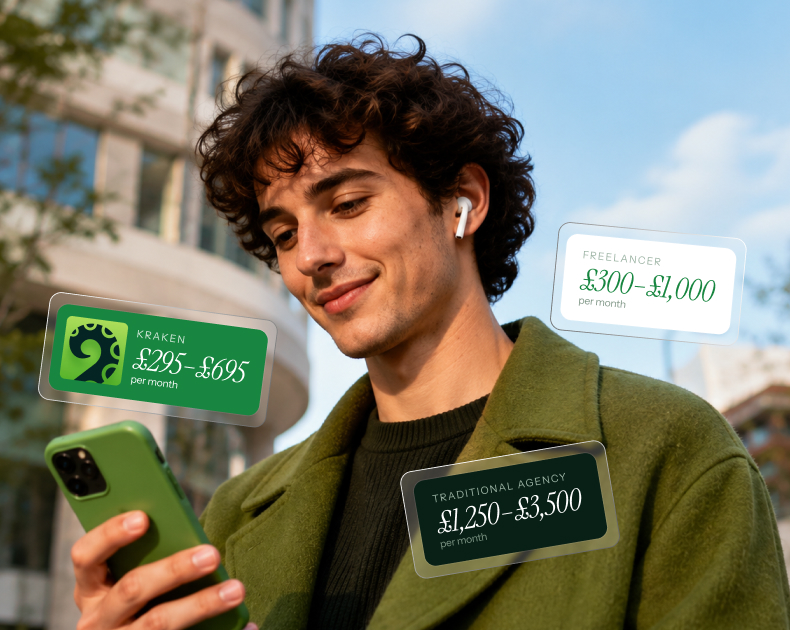
Real growth is slower, but it compounds into the only thing worth having: people who actually buy. If producing content good enough to earn that audience is the part you don't have time for, that's the exact job Kraken was built to do — a dedicated team, real designers, from £295 a month, with your first 30 days risk-free.
%20(1).png)