Content & Design
8 Minutes
Social Media Consistency: Why It Builds Brand Awareness
Last Updated
July 16, 2026

.avif)
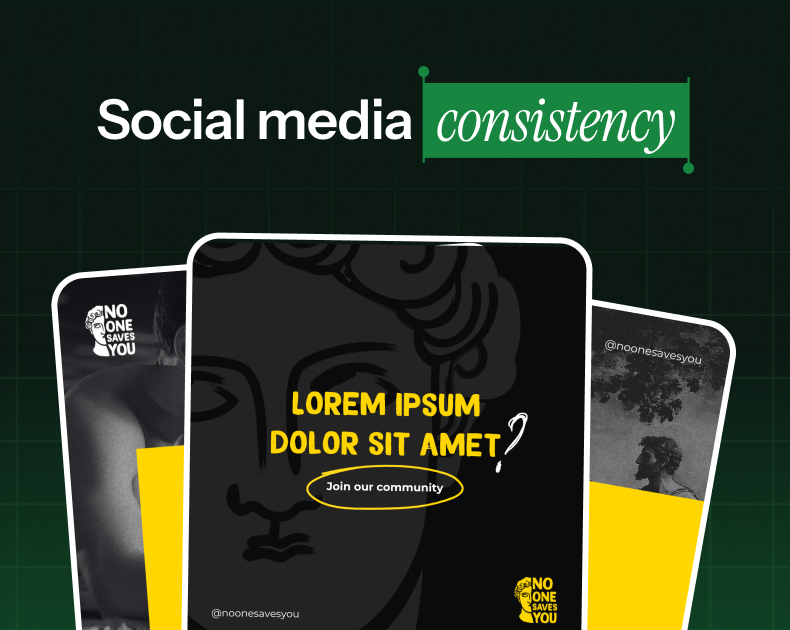
Open a dozen small business Instagram accounts at random and you'll see the same shape: a flurry of posts in January, silence by March, then a defensive comeback in June that fizzles out again by August. Social media consistency, not posting frequency, is what actually builds brand awareness: a predictable rhythm of on-brand content that trains both algorithms and audiences to expect you. Businesses that post three times a week, every week, consistently outperform ones that post daily for a fortnight and then vanish. The gap isn't effort. It's structure, and structure is fixable in an afternoon, not a rebrand.
Social media consistency is the practice of publishing on a predictable schedule, in a recognisable visual style and tone, whether the week has been quiet or chaotic. Frequency is simply a count: how many posts went out in a given period, with no reference to reliability or brand cohesion. A business can have high frequency and low consistency, or the reverse, and only one of those actually builds a brand.
The difference matters because they're often confused in the same sentence. "We need to post more" is a frequency goal. "We need people to recognise us the second they see our grid" is a consistency goal, and it's the one that compounds over time.
FrequencyConsistencyMeasuresVolume of postsPredictability and cohesionExample12 posts in one week, then none for three3 posts every week, on the same daysAudience effectShort-term visibility spikeLong-term familiarity and trustAlgorithm effectTemporary reach boost, then a drop-offSustained, compounding visibility
A business posting daily for ten days and then disappearing has high frequency and low consistency. A business posting three times a week, every week, with a recognisable visual style, builds far more lasting presence, even with a lower total post count.
Consistency builds brand awareness because predictability is what turns a stranger into a familiar name. When a business shows up reliably, with content that always looks and sounds like it came from the same place, audiences start to associate that reliability with competence and trustworthiness. A scattered feed, by contrast, reads as a business that might not still be trading.
This isn't just a feeling. Research from brand platform Marq (formerly Lucidpress), which surveyed over 400 brand management professionals, found that consistent brand presentation is associated with revenue increases of 10 to 20%, with some organisations reporting gains as high as 33%. The mechanism is trust: audiences who recognise a brand instantly are more likely to buy from it, recommend it, and stick around after the first interaction.
Across the 200-plus brands we manage at Kraken, we see this pattern constantly: new followers make their decision to follow within the first few posts they scroll past, not after weeks of watching the account. A feed that looks intentional from the first glance earns a follow. A feed that looks like three different people have been posting to it, with three different opinions about what the brand sounds like, doesn't, no matter how often it updates.
Yes. Social platforms are built to promote accounts that show a pattern of reliable activity and engagement, because an active, predictable account is more likely to keep users on the platform. Instagram's head, Adam Mosseri, has said publicly on more than one occasion that consistency matters more than sheer volume: a steady weekly cadence tends to outperform an aggressive but sporadic one, even when the total number of posts is the same.
This lines up with how the platforms themselves describe their ranking logic. Feed and Reels algorithms weigh signals like watch time, saves, and shares heavily, and those signals accumulate faster for accounts a user already has a "relationship history" with; commenting, saving, and returning to a profile repeatedly. An account that disappears for weeks resets a lot of that accumulated familiarity, both with the algorithm and with the humans watching it.
None of this means posting around the clock. It means picking a cadence and holding it, which is a very different exercise from chasing a daily quota.
There's no single right number, but there is a right number for your size and resources, and posting beyond what you can sustain is worse than posting less and holding the line. The starting point is honest capacity: how many well-made posts can your business realistically produce, review, and publish every single week, including the weeks things go wrong?
Business profileRealistic cadenceBest starting platformSolo founder, no support2–3 posts/weekOne platform your customers already useSmall team (3–10 people)3–5 posts/weekOne primary platform, second added laterMarketing manager with some budget5–7 posts/week across formatsPrimary platform plus one adjacent channel
A ten-person hospitality business, for instance, is usually better served by three sharp Instagram posts a week than by a thin daily effort spread across Instagram, Facebook, TikTok, and LinkedIn simultaneously. Nearly half of UK shoppers (47.7%) now use social media to find local businesses, according to Constant Contact's 2026 Small Business Now report, and the first things they check once they land on a profile are reviews and pricing information, not post count. A calm, well-run single channel beats five half-hearted ones.
Most consistency failures come down to three predictable mistakes, and all three are avoidable once you can name them. The first is platform sprawl: setting up accounts on every network at once and watching momentum stall because each channel competes for the same limited attention. The second is chasing volume over quality, which produces content nobody remembers and eventually stops engaging with. The third is treating posting as a one-way broadcast and ignoring the comments and messages that come back.
Any one of these can quietly derail a schedule that looked solid on paper in week one.
A workable consistency system replaces good intentions with a fixed weekly routine that survives busy weeks, because willpower alone rarely does. The structure needs to be light enough that a stretched founder or a marketing manager juggling eight other priorities can actually run it without a dedicated hire.
Across the 7,000-plus posts we've published for clients at Kraken, the accounts that hold their schedule longest are the ones where content creation happens in a batch, in advance, informed by what our social listening tool shows is actually performing in that client's specific industry that week, rather than being reinvented from scratch every time a post is due.
Consistency covers both timing and brand identity, and the second half is where most businesses quietly slip even when their posting schedule looks fine on paper. A recognisable logo placement, colour palette, and tone of voice glue a feed together across every post, so that a follower could identify the brand with the caption hidden.
ElementCheckpointReview frequencyLogo and coloursMatch brand guidelines exactlyMonthlyTypographyConsistent, no ad hoc template swapsMonthlyTone of voiceEvery caption sounds like the same "person"Every postApproval processAt least one reviewer before publishingEvery post
This is what a documented brand bible is for: a simple reference for voice, visuals, and tone that anyone touching the account, whether that's the founder, a new hire, or an outsourced team, can check a post against before it goes live. Without one, brand drift happens gradually and is hard to notice from the inside.
Paying someone to manage this is worth it once time, not skill, is the actual blocker, and it isn't the right move if you genuinely enjoy doing the posting yourself or need real-time, moment-by-moment trend-jacking that only an in-house voice can pull off convincingly. Traditional agencies typically charge upwards of £5,000 a month with contract lock-ins, which is out of reach for most SMEs, while freelancers are cheaper but often inconsistent and still require the client's own time to brief and check.
Kraken is a fully managed social media service that gives businesses a dedicated London-based team of designers, copywriters, and strategists who handle strategy, design, and posting for a flat monthly fee from £295 a month. It sits deliberately in the gap between those two options: agency-quality, brand-bible-approved output, without the contract or the constant babysitting. If you'd rather keep it in-house, that's a completely reasonable call too, provided you're honest about whether the [current cadence is one your team can actually sustain](INTERNAL: social-media-budget-small-business) through a busy season, not just a quiet one.
Where it isn't the right fit: if your brand's whole appeal rests on the founder's unfiltered, in-the-moment voice, or if you're already hitting a sustainable rhythm on your own, a managed service adds cost without solving a problem you have. It's worth being honest about that before signing up to anything.
What happens if I miss a few days of posting?
Missing an occasional day isn't a disaster; the algorithm and your audience respond to the pattern over weeks and months, not to a single gap. What matters is getting back to the schedule quickly rather than letting a short gap turn into a multi-week disappearance.
Should I post the same content on every platform to stay consistent?
No. Consistency means a recognisable brand voice and identity, not identical content everywhere. Adapt format and tone to each platform's conventions (a LinkedIn post reads differently to an Instagram caption) while keeping the underlying personality the same.
How long does it take before consistent posting shows results?
Most businesses start to see meaningful movement in reach, engagement, and enquiries over a three- to six-month window of steady posting. Shorter windows are usually too noisy to judge, since a single viral or quiet week can skew the picture.
Can I repurpose old posts and still call it consistent?
Yes, and you should. Turning a strong customer testimonial into a quote graphic, or a blog insight into a carousel, keeps quality high without demanding fresh ideas every single week.
Does consistency matter as much on LinkedIn as on Instagram or TikTok?
It matters on every platform, though the mechanism differs slightly. LinkedIn rewards a steady drumbeat of thought leadership and company updates over time, while TikTok and Instagram lean harder on frequent, immediate engagement signals like saves and shares.
Consistency, not frequency, is the lever that actually moves brand awareness: a predictable schedule, held even through busy weeks, paired with a look and tone that never changes depending on who's posting. Get the system right once, whether that's a simple weekly routine you run yourself or [a team that runs it for you](INTERNAL: get-started), and it keeps compounding without needing to be reinvented every month. If keeping that consistency is the part that keeps slipping, that's exactly the gap Kraken exists to close, risk-free for the first 30 days.
%20(1).png)