Small Business Marketing
10
How Do Subscription Social Media Services Work?
Last Updated
September 21, 2026

.avif)
A subscription social media service gives you a defined amount of strategy, design, copywriting, scheduling and publishing for a flat monthly fee. The real difference is operational: you buy a repeatable output rather than an open-ended allocation of agency or freelancer time. It works best for businesses that need consistent organic content without managing production themselves; it is a weaker fit when paid media, community management or highly reactive campaigns are the priority.
Ofcom’s 2025 data shows how broad the social audience now is in the UK: YouTube reaches 94% of adults and Facebook/Messenger reaches 93%. Ofcom’s Online Nation 2025 report (www.ofcom.org.uk) The harder problem for most SMEs is not deciding whether social matters. It is finding a way to keep producing credible content every week without turning somebody else’s job into social media management.
A subscription social media service is one answer. Instead of commissioning individual projects or paying a retainer against a broad scope, you subscribe to a defined level of ongoing output. The provider handles the production system; you supply the business context and approve the work.
That distinction matters more than the billing model. A good subscription service is cheaper to operate because the workflow, scope and approvals are standardised — not because the creative work has been removed.
A subscription social media service is a managed service that produces an agreed volume of social content for a recurring monthly fee. Depending on the provider, that can include strategy, post design, captions, scheduling, publishing, reporting and revisions.
The important word is agreed. You are not buying unlimited access to a marketing department. You are buying a clearly defined production system with boundaries around how much content is produced, which channels are covered and what happens when you request changes.
That makes the model particularly well suited to organic social media. Social is rarely a one-off project with a neat finish date. It is recurring production: plan, make, review, publish, repeat.
At Kraken Socials, for example, the three current plans are:
Those numbers make the trade-off visible before production starts. A business does not need to negotiate an hourly allowance and then wonder how much of it was absorbed by calls, revisions or account management.
You can see the current Kraken Socials service and plan details.
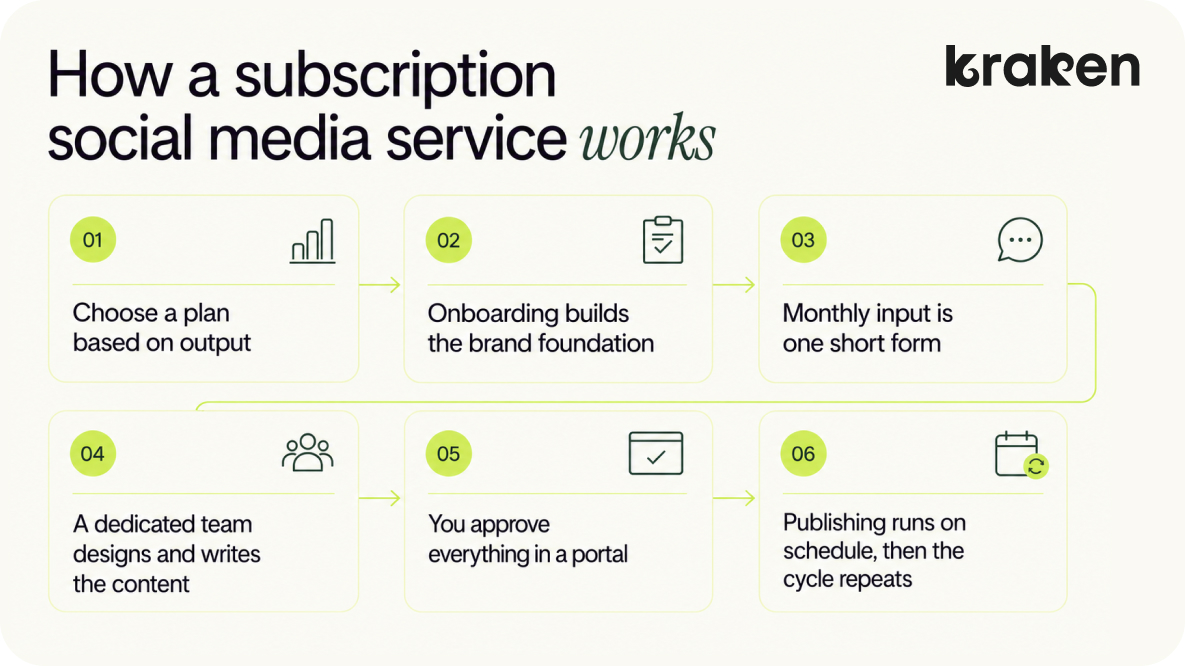
The basic cycle is simple: set the brand foundation, provide current business context, produce the content, approve it, publish it and repeat.
The quality of the service depends on what happens inside those steps.
The first decision should be volume, not aspiration.
More posts are not automatically better if the business cannot provide enough useful information, photographs, product updates or subject-matter input to sustain them. Three strong posts every week is usually more useful than committing to seven and filling the difference with generic material.
The subscription model makes that decision explicit. Your monthly cost is linked to production volume and channel coverage rather than an abstract bank of agency hours.
That predictability is useful for budgeting too. If you are comparing subscriptions with DIY, freelancers, agencies or an employee, our 2026 small-business social media budget guide breaks down the wider cost differences.
Outsourcing fails quickly when the provider has to rediscover the brand every Monday.
The better approach is to move the repeated context into a documented system. At Kraken Socials, onboarding includes a brand bible covering areas such as voice, visual direction, tone and the rules the team should follow when producing content.
This is not just a branding exercise. It reduces operational friction.
Without that foundation, every caption becomes a new briefing exercise. With it, monthly input can focus on what has changed: a new service, an upcoming event, a hiring push or a product that needs attention.
At Kraken Socials, the brand bible is built during onboarding and reviewed before ongoing production. That gives both sides something concrete to refer back to when feedback is subjective.
A social media provider can research your market. It cannot know that your founder is speaking at a conference next Thursday unless somebody tells it.
That is where the client's recurring input belongs.
At Kraken Socials, clients typically spend around 10 minutes a month supplying updates. That is the typical client input, not a claim that social media itself takes 10 minutes to produce. The production work is handled by the team.
Useful input normally includes:
The standing brand knowledge should already live in the system. Monthly input should carry the news.
Once the context is in place, the production team handles strategy, copy and creative.
This is one of the areas where subscription services vary considerably. Some are essentially template-production services. Others include strategists, copywriters and designers. Buyers should check who is actually making the content rather than assuming every subscription includes the same expertise.
Kraken Socials uses a dedicated London-based team of designers, copywriters and strategists. Social listening is used alongside the client's brief to inform decisions about topics, competitor activity and relevant formats. It informs the strategy; it does not guarantee reach, engagement or sales.
The creative process is also human-led. AI can be useful for research, drafting and repetitive production tasks, but brand decisions still need judgement. We cover that distinction in our guide to designer-made vs AI-generated social content.
Across 200+ brands and 7,000+ posts produced or published by Kraken Socials as of 2026, the operational advantage of the system is repeatability. The team does not need a fresh kickoff meeting every time another week's posts need making.
Approval is where a supposedly outsourced service can quietly put the workload back on the client.
Email chains, PDFs, screenshots and comments spread across Slack may all work for a few posts. They become cumbersome when the cycle repeats every month.
Kraken Socials uses a client portal where content can be reviewed before publishing. Clients can approve posts or request changes in one place, and unlimited revisions apply to the content included within the chosen plan.
That qualification matters. Unlimited revisions does not mean unlimited new content. It means the agreed posts can be revised until the in-plan content is ready to publish.
A provider should be equally clear about the distinction.
Once approved, content is scheduled and published to the agreed channels.
At Kraken Socials, first content is typically delivered within five working days. After onboarding, production settles into the recurring cycle rather than restarting as a new project every month.
The goal is not to remove the client from social media altogether. Businesses should still surface timely news, customer insights, photography and spontaneous content when it matters.
The subscription handles the production baseline so those contributions become additions rather than the only reason anything gets posted.
That distinction is important. Consistency works better when it comes from a system rather than somebody remembering to open Canva at 4pm on Friday.
A managed social media subscription should be very clear about scope. The flat fee only works because the boundaries are defined.
For Kraken Socials, the core service is centred on:
That covers the recurring organic content operation.
It should not be confused with every discipline that happens to involve a social platform. Unless specifically included by a provider, separate services may be needed for:
This is one of the strongest arguments for the subscription model and one of its genuine limitations.
A narrower scope makes the price predictable. It also means you should not buy a content subscription when your actual problem is paid acquisition or customer support.
The difference is not simply price. Each model puts responsibility in a different place.
A freelancer usually gives you direct access to one person's expertise and can be highly flexible. That is especially valuable when you find someone with deep experience in your exact industry. The trade-off is that briefing, quality control, workload management and absence cover may still sit with you.
An agency is stronger when the brief crosses disciplines. If you need organic content, paid advertising, campaign strategy, creators, media buying and wider marketing support under one roof, the broader retainer can be entirely justified.
An in-house hire gives you proximity and business knowledge that an external provider cannot fully replicate. It makes most sense when social media creates enough ongoing work to occupy a skilled person properly. For context, Indeed reported an average UK social media manager base salary of £34,522 a year in August 2026, before the wider cost of employment. Indeed’s UK social media manager salary data (Indeed)
A subscription service sits between those options.
Its advantage is not unlimited flexibility. It is the opposite: enough standardisation to make ongoing professional production predictable.
You give up some of the open-ended scope of an agency in return for a clearer deliverable, lower management overhead and a fixed monthly cost.
The same mechanisms that make the model efficient also create its limitations.
Volume is defined. If your plan provides five posts a week and a launch suddenly requires a large amount of extra creative, that additional workload needs to be dealt with separately or through a different plan.
Scope is deliberately narrow. A content subscription is not a replacement for a full marketing department. If your biggest challenge is Meta Ads, creator partnerships or answering hundreds of customer DMs, buy expertise in those jobs instead.
There is still an onboarding curve. A new external team does not arrive with years of institutional knowledge about your company. A good onboarding process shortens that learning curve; it cannot make it disappear.
You still need to provide business-specific material. A designer can produce polished branded content without a weekly photo shoot, but no provider can manufacture genuine access to your team, customers, products and day-to-day operations.
That becomes especially important for businesses where real-world material is the product: hospitality, construction, events, property, manufacturing or founder-led brands.
A useful subscription therefore reduces the client's workload rather than pretending the client contributes nothing.
The price tells you very little if you do not know what production system sits behind it.
Before choosing any subscription social media service, ask six things:
Also check cancellation terms and guarantees before paying. Kraken Socials currently requires 28 days' notice for cancellation and publishes a 30-day money-back guarantee.
The best subscription is not the one claiming to do the most. It is the one where you can tell exactly what will happen after you pay.
A subscription service is a strong fit when the underlying problem is production: the strategy broadly exists, social media needs to stay active, but nobody has the time or specialist capacity to keep planning, designing, writing and publishing every week.
Choose a freelancer when one person's specialist expertise or flexibility matters most. Choose an agency when you need broader campaign capability, particularly paid media or disciplines outside organic content. Build in-house when social is important enough to justify permanent capacity.
Choose a subscription when you want the recurring production problem converted into a predictable system.
Kraken Socials is a fully managed social media service that gives businesses a dedicated London-based team of designers, copywriters and strategists handling strategy, design and posting for a flat monthly fee from £295 a month. Clients typically provide around 10 minutes of input monthly, approve content before it publishes, and can use the published 30-day money-back guarantee to assess whether the model fits.
The value is not that you never think about social media again. It is that social media no longer depends on somebody finding spare time to make it happen.

How much does a subscription social media service cost?
Pricing depends mainly on content volume, formats and number of channels. Kraken Socials currently starts at £295/month for Launch, which includes three posts a week across three channels. Pro costs £495/month for five posts across four channels, while Scale costs £695/month for seven posts across five or more channels and includes motion and short-form content.
How much time does the client need to spend each month?
Kraken Socials clients typically provide around 10 minutes of monthly input covering upcoming activity, changes and useful source material. Approval time varies depending on the amount of feedback required. The purpose of the model is to remove production work, not to remove useful business context from the process.
Will outsourced social media content actually sound like our business?
It can if the provider documents the brand properly before production begins. Kraken Socials creates a brand bible during onboarding covering voice, tone and visual direction, then uses it as the standing reference for future work. Monthly feedback also helps the team refine execution over time.
Can I ask for unlimited changes?
At Kraken Socials, unlimited revisions apply to in-plan content. You can request further changes to the posts included in your plan before they publish, but unlimited revisions should not be interpreted as unlimited extra posts or work outside the agreed service scope.
Does a social media subscription include paid ads and community management?
Not necessarily. Kraken Socials primarily covers organic strategy, content creation, copywriting, scheduling and publishing. Paid advertising, influencer management and hands-on community management should be treated as separate requirements unless a provider explicitly includes them in its scope.
%20(1).png)